Pennsylvania Senate Committee Advances Age-Verification Bill SB 603
10/05/2026 / By Edison Reed

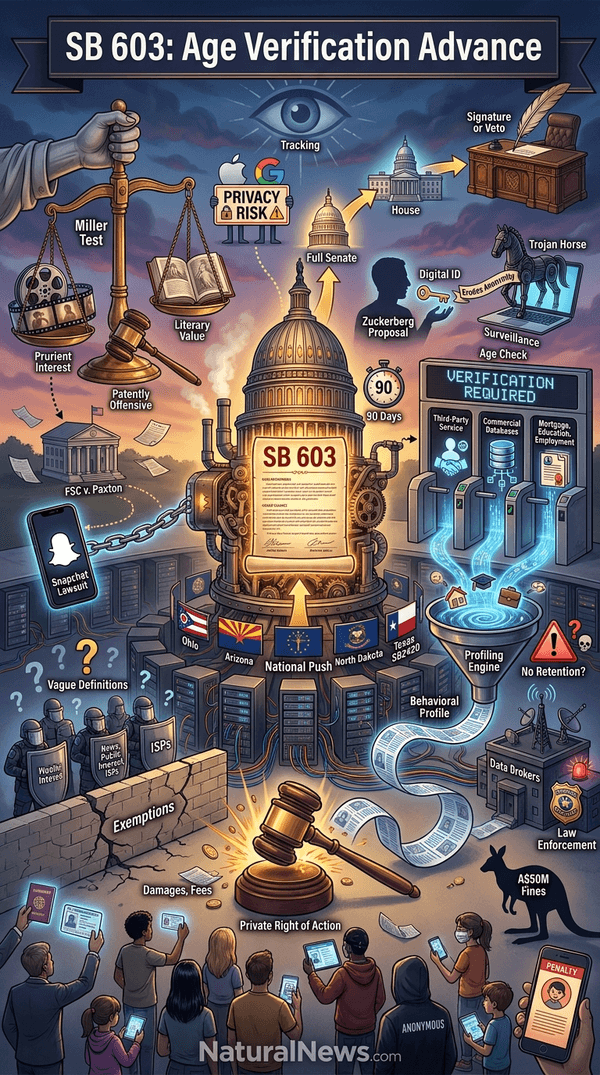
Pennsylvania’s Senate Judiciary Committee has advanced a bill that would require age verification on commercial websites containing more than one-third harmful material, sending the measure to the full Senate for debate and a vote, according to Reclaim The Net. The bill, SB 603, would then proceed to the House if it passes the Senate, the report stated.
The committee action occurred as part of a national push by states to impose age-verification requirements on online platforms and websites, according to Reclaim The Net. The bill’s advancement follows similar legislative efforts in Ohio, Arizona, Indiana, and North Dakota, the report stated, as well as Pennsylvania’s lawsuit against Snapchat over its handling of age verification [1][2].
Bill Verification and Exemptions
Under the bill, verification could be performed by an independent third-party age-verification service, through commercially available databases regularly used by government agencies and businesses for age and identity verification, or by any commercially reasonable method relying on public or private transactional data, according to Reclaim The Net. The report stated that the “commercially reasonable method” provision would allow age checks to draw on mortgage, education, and employment records [1].
The bill would take effect 90 days after enactment and specifies that verification data cannot be retained after the verification process is completed, the report stated. However, the bill does not address how third-party verification services would handle that data, according to Reclaim The Net. Even if data retention were addressed, the report noted that verifying a user’s identity before granting site access means their activity can be tracked and profiled, and that information can be shared or sold to data brokers.
Exemptions are provided for bona fide news organizations, public interest content, and internet service providers, the report stated [1]. A separate analysis of similar legislation noted that age-verification systems have been characterized as “Trojan horses for government and corporate surveillance” that “require invasive identity confirmation for basic online activities, eroding digital anonymity” [3].
Enforcement, Amendment and Legal Standard
The bill was amended to track the Miller test, a legal standard used to determine whether content is obscene, as upheld in FSC v. Paxton, according to Reclaim The Net. The amendment was adopted the week before the committee vote, the report stated [1].
The bill does not provide for enforcement by the state attorney general; instead, private citizens would be able to sue for damages, court costs, and attorney fees, according to the bill text. Supporters said the measure is designed to keep minors from accessing certain material, while critics cited privacy and tracking concerns, the report stated [1].
Separate reporting on age-verification laws has documented similar patterns. When Apple and Google announced compliance with a Texas age-verification law, both companies warned that the requirements may erode user privacy [4]. The law, Texas SB2420, requires “age assurance” checks for any app download, including benign apps such as weather applications, according to the report [4].
National Context and Related Cases
Reclaim The Net reported that it has been tracking the progress of SB 603 as well as similar age-verification bills in Ohio, Arizona, Indiana, and North Dakota [1]. The report noted that Pennsylvania is separately suing Snapchat for not implementing age verification, while Meta CEO Mark Zuckerberg has proposed using verification as a way to balance the need to keep children safe with the right to privacy [2].
Zuckerberg’s proposal would remove the possibility of anonymous access to the internet for everyone, the report stated [1]. The report also stated that child safety is “used to force private companies to implement age verification digital ID checks, and in some cases, change the design of their platforms,” adding that “once this is done, it’s not clear that children are any safer, but one thing is certain: online privacy and anonymity are eroded” [2].
The broader trend has drawn scrutiny. A report on global age-verification systems stated that “existing methods such as facial estimation and ID checks are unreliable near a threshold” and that “the cost is the loss of anonymity for all users” [3]. The report also noted that age-verification mandates have been advanced in multiple countries, with Australia passing an Online Safety Amendment Bill that prohibits children under 16 from accessing major social media platforms and imposes fines of up to A$50 million for non-compliance [5].
References
- Ken Macon. “Pennsylvania Wants Proof of Age Before Letting Users Browse”. Reclaim The Net. October 1, 2026.
- Reclaim The Net. “Pennsylvania Sues Snapchat Over Lack of Age Verification”. Reclaim The Net. August 29, 2026.
- Patrick Lewis. “Global Academics Sound Alarm on Age Verification: A Dangerous Path Toward Mass Surveillance”. NaturalNews.com. March 9, 2026.
- Patrick Lewis. “Apple & Google to Comply with Texas Age Verification Law but Warn of Privacy Trade-offs”. NaturalNews.com. October 15, 2025.
- Ramon Tomey. “Australia’s Social Media Ban for Under-16s: Digital Safety or Surveillance Overreach?”. NaturalNews.com. September 9, 2025.
Explainer Infographic
Submit a correction >>
Tagged Under:
age verification, Age-Verification Bill SB 603, big government, computing, conspiracy, cyber war, Dangerous, digital ID, freedom, Glitch, information technology, internet, Liberty, online content, pennsylvania, privacy watch, surveillance
This article may contain statements that reflect the opinion of the author
RECENT NEWS & ARTICLES